Personal photography throughout the ages
Since its inception, photography has gone through an immense amount of change, particularly in the last 20 years where traditional forms of photography have almost entirely shifted to digital forms.
As theorist Sontag notes, photography to most people is less an art form, but rather a way of holding onto personal memories and identities. (Sontag, 1977) As she best puts it, photographs "furnish evidence" (Sontag, p. 5) and additionally are a "defence against anxiety" (Sontag, p. 8) for those who fear that their experiences will not be validated without evidence in the form of visual representation.
In this post I intend to explore personal photography throughout the ages, giving five CC licensed personable photographic examples from different time periods, examining the contextual and/or visual differences in the photos. Each photo will be compared against Sontag's theory that photography is partly used as a social rite- in other words, a custom, and a way to celebrate life events.
What constitutes 'personal photography'?
- "As she best puts it, photographs "furnish evidence" (Sontag, p. 5) and additionally are a "defence against anxiety" (Sontag, p. 8)
- Practiced as a leisure
Sontag's theory: photography as a social rite?
- Customary
- Celebrates familial life
- "Defence against anxiety" (Sontag, 1977, p.8)
Late 1800s - Early 1900s
 |
| This is a photo of parents posing with their deceased daughter from the Victorian era. Post-mortem photography was popular in this time, and used as a way to honour memory and familial life with the "materiality" (Fernandez, 2011, p.346) of the corpse's body |
1910s
 |
| A portrait of a soldier from WWI. Private Harry Witherick Baxendale by Named Faces from the Past is licensed under CC BY-SA 2.0 In Cox' writing, he references Rose's idea of portraiture being a way in which families collect photos throughout the generations (Cox, 2012, p. 63) |
1930s
 |
| The Migrant Mother, 1936 Migrant Mother by David Erickson is licensed under CC BY 2.0 An iconic photograph which sums up the general feeling during the Great Depression in the US This is one of the first examples of social-realist photography. |
1940s
 |
| Bride and groom Groom is pictured in his military uniform, contextually representing war time. Photography makes an experience tactile (Sontag, 1977, p. 10) |
1970s
 |
| Tourism - Japanese tourists documenting their travels Personal photography use has grown in conjunction with one of the most popular modern day activities, tourism (Sontag, 1977, p. 9) As Sontag notes, photography use as a tool to give shape to experience is common in this time period in highly industrialised, white-collar countries, like the US and Japan (Sontag, 1977, p.10) |
1980s
 |
| Personal photography in the 1980s demonstrates advancements in camera technology. Formal portraiture styles begin to take on more of a casual approach. Poses are more natural, and seemingly happier - despite terrible 80s-style haircuts. The 1980s is also noted as the time where personal photography began to be valued as "collectable commodities" (Grosvenor & Macnab, 2015, p. 130) |
2000s
 |
| This photo evidences the rise of blogging and photographing the mundane aspects of everyday life. Coffee time at Acres cafe in Richmond by Katherine Lim is licensed under CC BY 2.0 Although food blogging may not be a way of representing familial events, Cox notes it can be used as a way to define the self (Cox, 2012, p. 69) Therefore, it is a form of personal photography. |
Photographic modes and outlets: past vs. present (and modes/outlets which are seen in both)
Present:
 |
| This photo by Fuzheado is licensed by CC BY-SA 3.0 With camera phones comes a new photography culture where photos are intended for "momentary fun and consumption" as opposed to "lasting value" (Villi, p. 92, as cited from ibid., p.58-59) |
 |
| Instagram-logo by Jose Moutinho is licensed under CC BY 2.0 Instagram acts as a platform for sharing personal photos online. |
Common in both past and present:
 |
| Vintage Railway Album: cover by James Morley is licensed under Public Domain Mark 1.0 Photo albums have been used throughout the ages to categorise and display images. (Sontag, 1977) |
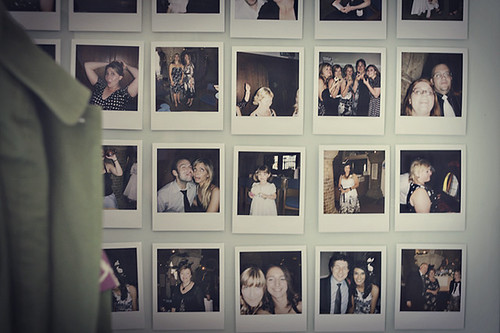 |
| polaroid wall by Shimelle Laine is licensed under CC BY 2.0 Similarly, photographic wall hangings (In this case, polaroid shots) have been a popular way to represent and retain memory throughout the ages |
Past:
 |
| Daguerrotype - Louis Daguerre's invention, important in further developing photography practices |
 |
| Camera obscura - the modern camera's predecessor |
Personal photography to this day, remains professional or amateur in nature. It can be practiced as a leisure, but is more often a form of giving tactile evidence to memories (Sontag, 1977)
What distinguishes present-day personal photography to traditional forms includes the rise of more casual-style shots. In addition to the idea that photography is becoming more disposable (Villi, 2010, p. 92) This is based on the fact that the process of taking a photograph is more accessible and easier than ever before, due to its digitalised nature.
What we value as photography-worthy is also experiencing a shift as time progresses. Where photography was once associated with capturing significant personal events in "family life" (Sontag, 2010, p. 8) we now value capturing the mundane moments in everyday life.
Despite shifts in what we value in personal photography, there are two ideas which remain intact when it comes to personal photography.
- 1) "Defence against anxiety" (Sontag, 2010, p.8) The idea that personal photography is used as a way to document memories and reminisce about those memories in future
- 2) "Everything exists to end in a photograph" (Sontag, 2010, p. 24) In other words, photographs are an important aspect of evidence, and have a strong link to every aspect of daily life.
